

Tom BatemanState Department correspondent travels on Air Force One
US President Donald Trump’s day-long trip to the Middle East came as the Gaza deal was sealed, an agreement that came into effect and marked one of the most critical moments yet after two years of catastrophic war.
Painting in primary colors, Trump’s portrait was vivid: of the greatest turning point in three millennia. On the return flight in the early hours of Tuesday he reflected that it had been a “historic day, to say the least”. He had previously suggested that ‘eternal peace’ had been achieved under his watch, in a region long plagued by violence.
As part of the White House press corps, we traveled on Air Force One – and so I found myself at the center of this American diplomatic tornado.
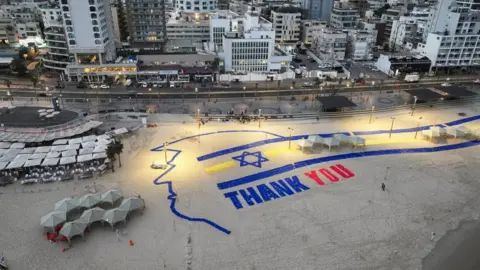
As we headed to Tel Aviv, the presidential plane turned to fly along the beach. He lowered one wing so we could see a giant sign on top of the sand that said “thank you” to Trump, with the Israeli flag and an outline of the American president’s head in profile.
 Reuters
The maneuver set the tone for a trip that was a victory lap, rather than an exercise in laying out the punishing details of starting “phase two” of negotiations and securing a longer-term future for Gaza.
The agreement concluded last week in Doha came under heavy pressure from Trump on both sides. It marked one of the most profound moments for millions of people in the past two years: major combat operations in Gaza ceased, the remaining living hostages held by Hamas were released in exchange for Palestinian prisoners held by Israel, and Palestinians in Gaza returned to the ruins of their homes in the north amid a partial withdrawal by Israeli troops.
But I discovered that Trump’s journey was actually to a waypoint, not a destination — a fragile truce in a centuries-old conflict that shows no real signs of resolution.
The most immediate question hanging over the trip was whether Trump’s deal could hold up — and whether more intense, arguably tougher negotiations could now build on it.
During the flight, Trump came back to talk to us. Standing in the doorway as we gathered around, he clearly wanted to build the sense of achievement, often referencing his own role in negotiating the deal.
“Every country is dancing in the streets,” he said repeatedly. I asked him if the ceasefire would remain intact. He was confident, saying there were “many reasons why it would hold up.” But he glossed over the really big questions about what comes next, especially how to secure and govern Gaza.
I asked him about the proposed multinational force, the International Stabilization Force (ISF), which is outlined in his twenty-point plan but whose existence has yet to be agreed upon by the parties.
“It’s going to be a big, powerful force,” Trump said, adding that it “barely” needs to be used because “people are going to behave, everyone knows their place.”
On the tarmac in Tel Aviv, Israeli Prime Minister Benjamin Netanyahu greeted Trump with a red carpet and a military band. We then zoomed in the convoy towards Jerusalem, along the Route 1 highway that had been completely cleared for the presidential convoy.
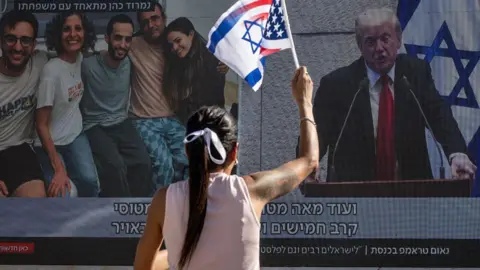
That same day, thousands watched a giant screen in a public square in Tel Aviv that has become known as Hostage Square. They cried with joy and relief when the hostages were released by Hamas in Gaza. Trump’s arrival was the other half of this split-screen moment: footage was broadcast of the American president setting foot on Israeli territory.

 Getty Images
Inside the chamber of the Knesset, or Israeli parliament, the mood was generally more raucous than on the streets. The red baseball caps distributed by staff and worn by some of the public bore the words: “The President of Peace”. Spectators shouted from the gallery behind me, “Thank you Trump.” Lawmakers hammered on their desks. Trump hailed a “historic dawn of a new Middle East.”
He also wanted to leave little doubt that the war was over, and it seemed that he expected it to remain so: Israel, he said, had won all it could “by force of arms” with America’s help. His speech culminated in extensive attacks on his political opponents in the US. He praised a major donor to his election campaign, sitting in the stands.
And he even appealed to Israeli President Isaac Herzog, who was sitting next to him, to pardon Netanyahu, who is on trial for corruption – charges the Israeli prime minister denies. “Cigars and champagne, who cares about that?” Trump exclaimed, referring to the claim that Netanyahu accepted expensive gifts.
The White House press officers who escort the press pool – the “wrestlers” – took us back into the press vans and the motorcade returned to Ben Gurion Airport after less than seven hours in Israel.
We took the short flight to Sharm el-Sheikh in Egypt; location of the mediated talks between Israel and Hamas that led to last week’s breakthrough. Egyptian F16s escorted us during our descent – the ultimate show for the president who loves displays of military might. Trump had wanted to celebrate every minute of the day.
But the dangers in this region are many, and the risk seemed clear of him announcing the ultimate deal before actually securing it.
This was reflected in the giant sign, written in capital letters, above the presidential podium in Sharm el-Sheikh: “PEACE IN THE MIDDLE EAST”. There I witnessed the extraordinary sight of world leaders streaming into a room to stand behind Trump as he delivered his speech praising peace. They lined up in front of their national flags and listened as he listed their countries one by one. Trump was introduced on stage by the host, Egyptian President Abdel Fatah el-Sisi, who said the goal remained a two-state solution between Israelis and Palestinians.
Trump has changed his position significantly since the beginning of this year. He became increasingly irritated with the Israeli leadership and grew closer to his friends in the Gulf. That came amid a diplomatic push by the Europeans to isolate Israel over the escalating campaign in Gaza and to rally Saudi leaders to their views. Trump then changed, attracted by his Gulf allies – whose wealth and “power” he often referred to during the drip.
Trump presided over the signing ceremony in Sharm and said it had taken “3,000 years” to get here. But there are still many years to go – and it will take more than one man to get there.
#hours #Trump #diplomatic #tornado #Middle #East