

Toyota has sold more than 3 million Highlanders since the model’s introduction in 2000, when it was one of the first unibody midsize crossovers to hit the market. In 2005, the first-generation Highlander became Toyota’s first SUV with a hybrid powertrain, at a time when most other automakers hadn’t even considered electrifying Prius-like cars. The current fourth-generation Highlander has been around since 2019 and remains a global model, but in 2023 Toyota released the larger, US-focused Grand Highlander SUV. With more space and more advanced hybrid powertrains, the Grand Highlander has quickly become the best-selling of the two: Toyota sold nearly three times more Grand Highlanders in the U.S. last year than regular Highlanders.
Apparently that’s why Toyota is taking a more radical approach with the fifth-generation Highlander, which just debuted during the first drive event for the bZ Woodland and C-HR. The 2027 Highlander will only be offered with an all-electric powertrain, and it seems like a solid entry into the still fairly sparse three-row EV field.
Full disclosure: Toyota invited me to drive to Ojai, California, and put me up in a hotel for a few nights so I could see the Highlander EV and drive the bZ Woodland and C-HR.
Two battery packs, two power levels
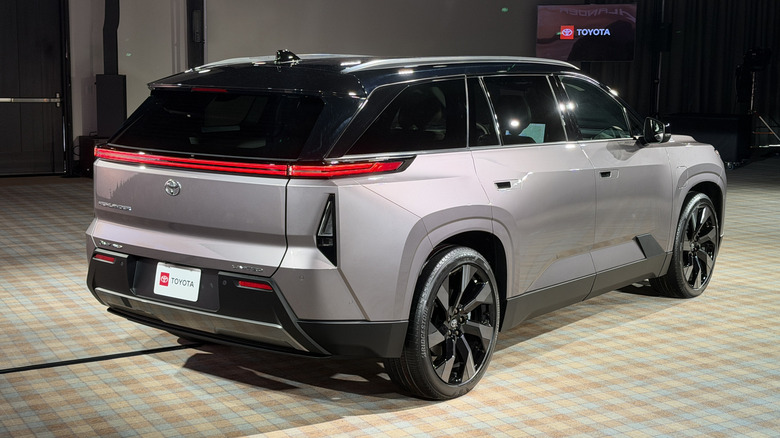
Toyota is launching the Highlander EV in two equipment levels, with two different battery pack sizes and front- or all-wheel drive. The base If you want all-wheel drive, Toyota adds a second motor to the rear axle that boosts total output to a healthy 338 hp and 323 lb-ft, matching the facelifted bZ (although the bZ Woodland has 375 horses). Toyota’s estimated range drops to 270 miles. If you opt for an AWD Highlander, you also get off-road driving modes and crawl control.
 Daniel Golson/Jalopnik
If that’s not enough, a 95.8 kWh battery pack is optional on the XLE AWD and standard on the Limited, which is only offered with the dual-motor setup. Both Highlanders have a range of 320 miles, according to Toyota. 19-inch wheels with aero caps are standard, but you can get the Limited with 22s; Of course, Toyota doesn’t say what kind of range you’ll get if you do. The automaker also isn’t saying what kind of DC fast charging speeds the Highlander can handle – it’s likely the same 150 kW as Toyota’s other EVs – but it will have a NACS charging port and can go from 10% to 80% in about 30 minutes. (Toyota also hasn’t said whether that figure is the same for both battery packs.) The Highlander is also the first Toyota in the U.S. to have vehicle-charging capabilities.
Lower and longer
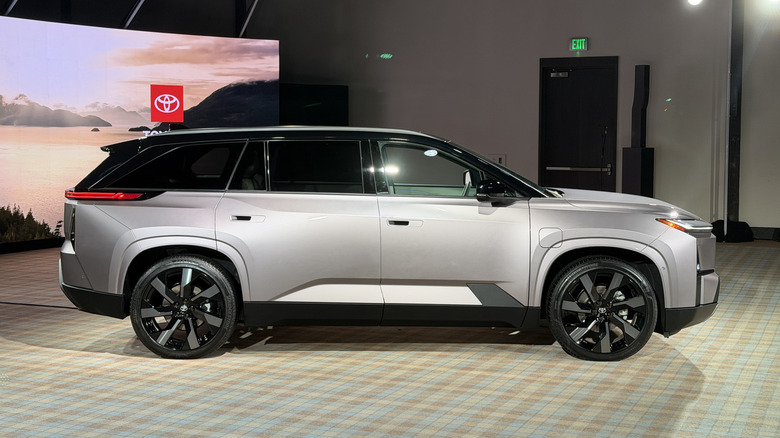
Those revised dimensions, squared off wheel arches and blocky proportions go a long way towards making the EV more interesting to look at than the old Highlander, but it’s the design details where Toyota has really put effort into this. It has Toyota’s recent signature hammerhead shark look up front, with thin running lights running across the nose and the headlights themselves in small angular pods below.
 Daniel Golson/Jalopnik
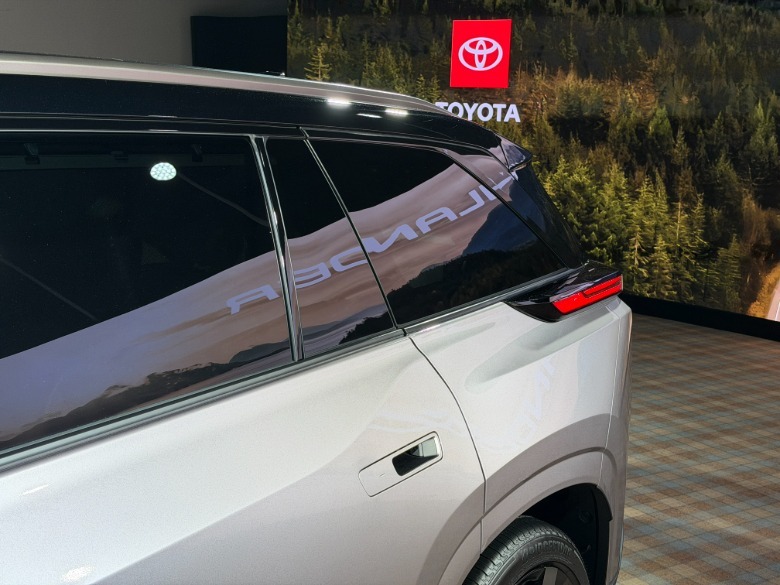
Walk around to the side of the Highlander and things start to get weird, I think in a good way. The lower doors have a beveled section with a slanted fin emerging from the lower trim, and the recessed door handles feature button-operated electronic locks, as on new Lexus SUVs. My favorite element is the treatment of the rear fender, with horizontal character lines that flow into the thin wraparound taillight. It makes the Highlander look downright muscular. At the rear, the turn signals are housed in triangular pieces that mark the lines in the tailgate and bumper. It’s angular and more futuristic than other new Toyotas, but still nice and sleek.
It’s a little weird inside, and that’s okay
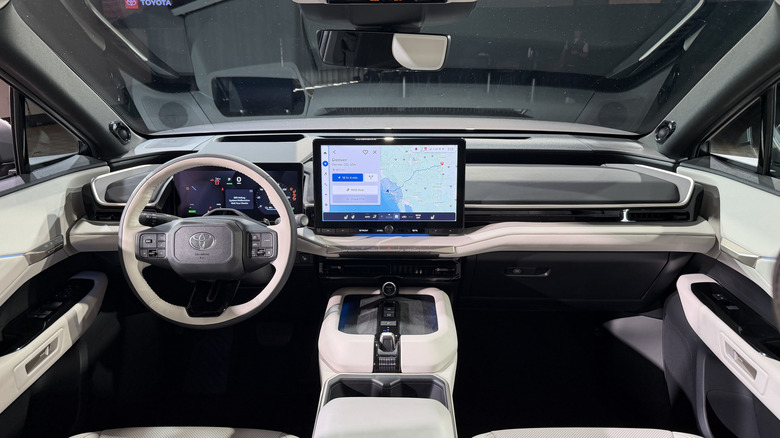
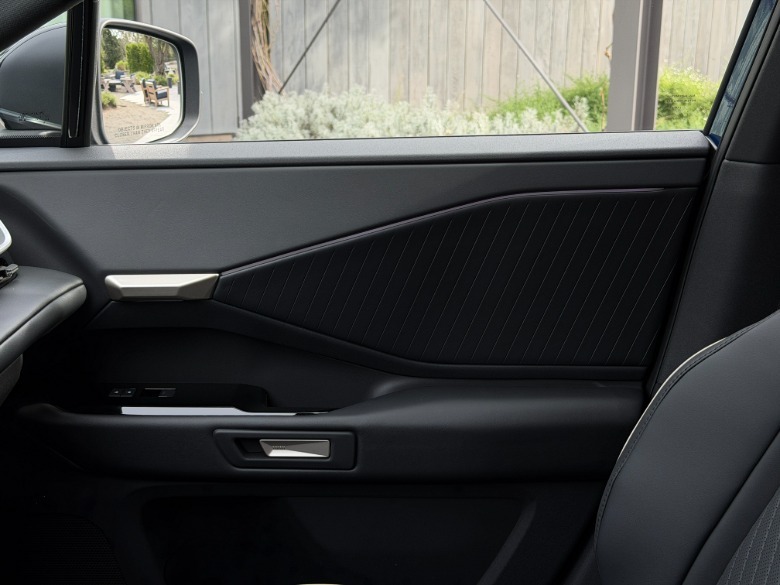 Daniel Golson/Jalopnik
The Highlander I got to poke around for the reveal was clearly a pre-production model, so I’m not going to pass judgment on build quality, but there’s a nice mix of soft-touch materials and finishes. My favorite detail is the strange three-dimensional door cards, which have ambient lighting strips leading to a flap covered by metal detailing (and the driver’s seat memory controls). It’s a design that feels very un-Toyota in a good way. Depending on the equipment level and color scheme, the seats and door panels have different perforation and stitching patterns, including a cool line motif.
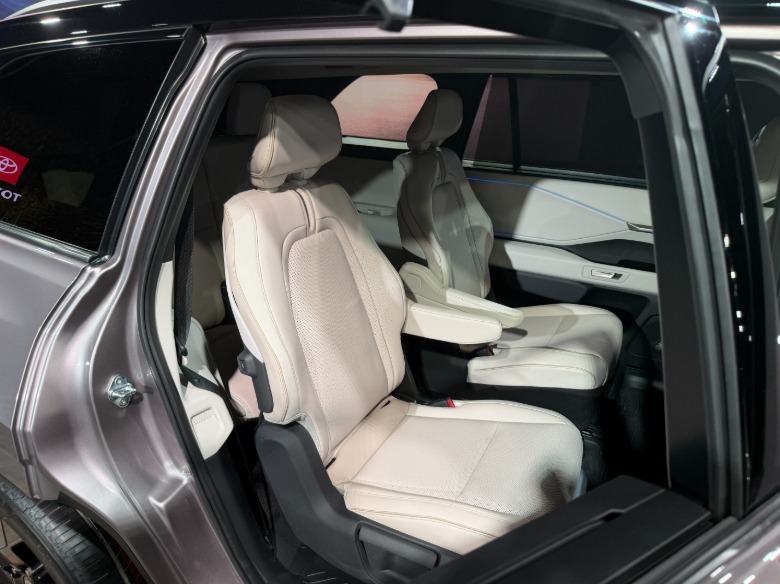 Daniel Golson/Jalopnik
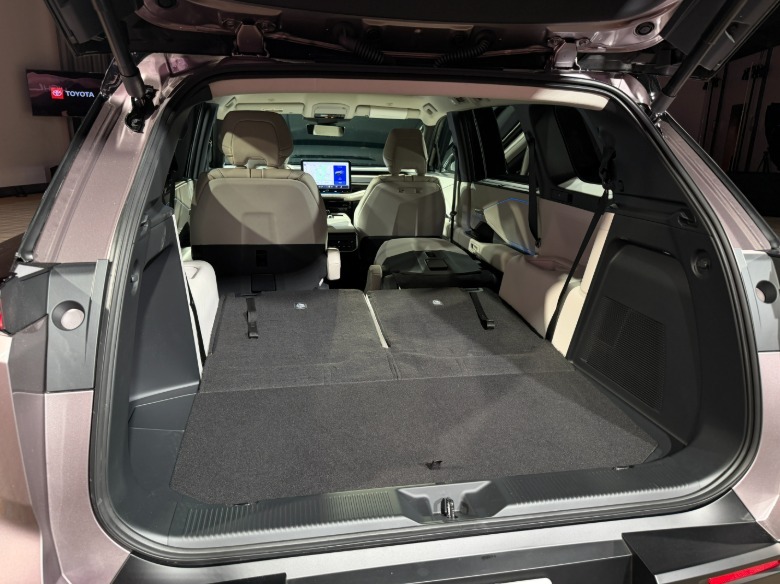
With all three rows of seats up, the Highlander EV has 15.9 cubic feet of cargo space, just a tenth of a cube less than a Highlander hybrid. Fold the second row flat and that grows to 45.6 cubic feet, a few cubes less than the hybrid; Toyota didn’t provide cargo figures with the second-row seats folded, which aren’t perfectly flat. They slide forward and back with ease, and there is a special button that allows them to slide forward and fold the backrest. The third row has a pair of seats, and on almost every version of the new Highlander, the second-row seats are a pair of captain’s chairs, although a three-way bench seat is available. With the captain’s chairs you get a console between them with storage space and cup holders.
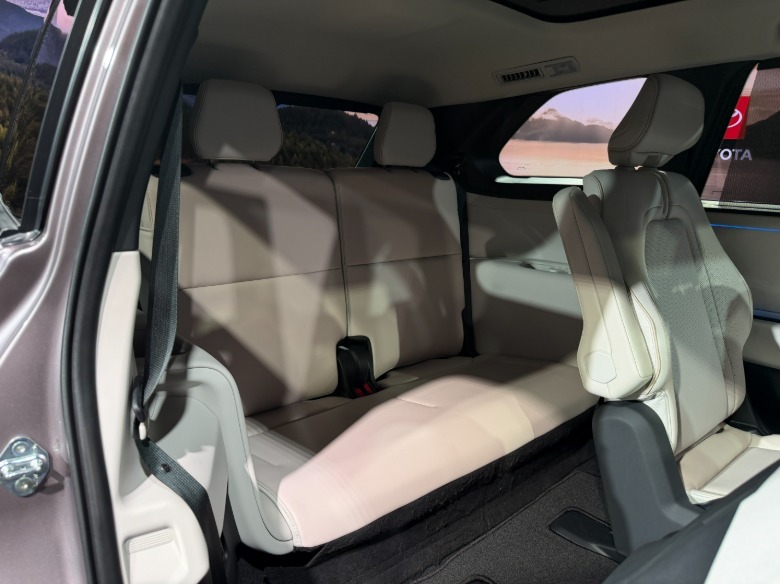 Daniel Golson/Jalopnik
The floor is virtually flat, apart from a slightly raised area in the second row that makes sliding rearward easy, and the cabin generally seems very spacious and airy, especially with the optional panoramic glass roof. My 6-foot-2 self can easily get in and out of the third row, and the second-row seats seem comfortable. The driving position is also nice, and it doesn’t have the strange instrument cluster and steering wheel layout used in the bZ. Paddle shifters are used to adjust the levels of regenerative braking.
We don’t know yet how much it will be
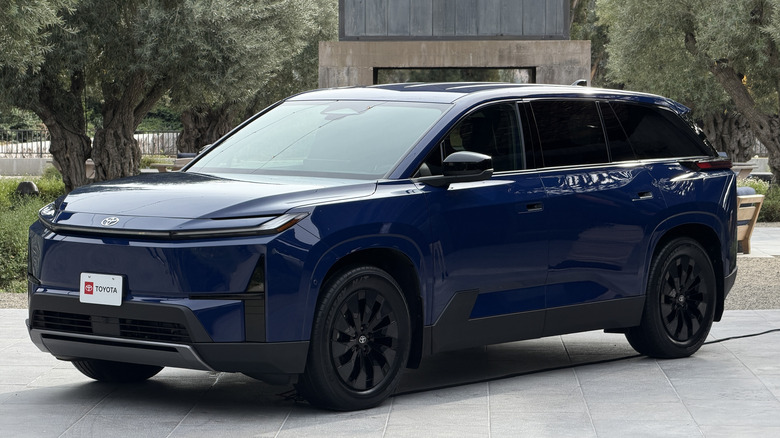
If you go for the Limited, you get ventilated front seats and heated second-row seats, a head-up display, memory for the side mirrors, rear sunshades, traffic jam assist, automatic lane change, front cross-traffic alert, advanced parking assistance and a 360-degree camera system. An 11-speaker JBL sound system is offered on the XLE AWD and Limited, and you can get the LImited with two-tone paint and 22-inch wheels.
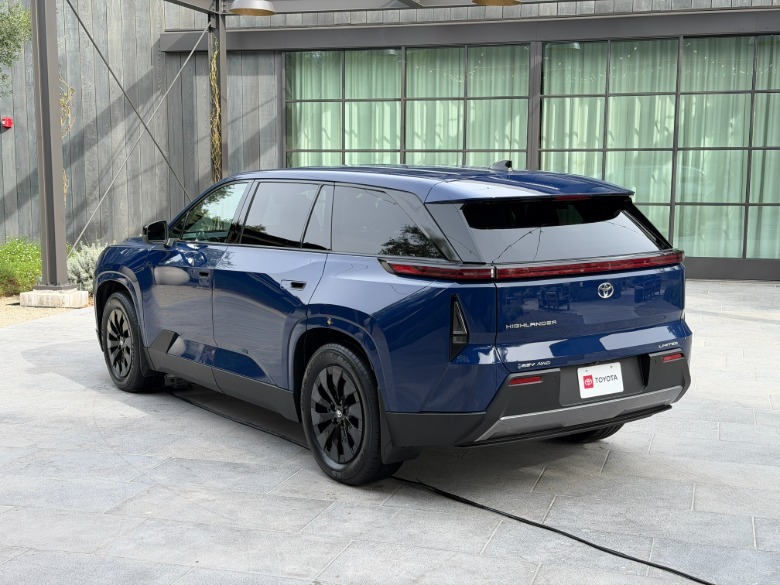 Daniel Golson/Jalopnik
We don’t yet know how much the 2027 Highlander will cost, but if I had to guess, it will come in somewhere between $50,000 and $55,000 for the base XLE with front-wheel drive. Toyota says the Highlander will be assembled at its plant in Georgetown, Kentucky, and the batteries will be produced at its new $13.9 billion manufacturing facility in Liberty, North Carolina. The electric Highlander will be on the market at the end of 2026.
#Toyota #Highlander #electric #miles #range #interesting #design #Jalopnik