

An old friend called me recently and while we were catching up, we landed on the topic of investing.
With all the uncertainty in the world, with artificial intelligence and large language models constantly evolving, and with market valuations as high as they are… what’s an investor to do? Where should we put our money?
You can make a case for almost anything. The market is overvalued and that is why the S&P 500 is bought when the price rises The Shiller PE ratio is 40 feels insane. The average ratio is around 17. But the market is performing well! And has performed well even at such high ratio levels!
Add to that how AI and LLMs are turning the world upside down. I don’t envy the position that high school students currently find themselves in when deciding what to do with their lives. Law and coding do not seem to be fields where you will have a good time as a starting employee.
Even though it feels uncertain, one thing we forget is that the future is always uncertain.
Is the market overvalued? Invest anyway.
The economy looks weak? Invest anyway.
AI taking over? Invest anyway.
But despite that uncertainty, you have to take action.
We won’t know what the stock market will do next week. Or month. Or year. The Fed will make its decisions, the markets will react and we may enter a recession. Maybe not. The media has been talking about a recession for two to three years, but it has yet to materialize. Or influence the stock market.
But in the long term, we think it will increase.
That’s why it’s still smart to contribute to your retirement, even if the PE ratios are insane.
To hammer this house, I want to show you two charts:
First, there is always a reason to sell. (Or don’t buy.)
It comes from Ritholtz Asset Management and shows how historically there is always a reason to sell your shares. Figures on bad jobs. Fear of recession. Pandemic. It’s a non-stop stream of bad news. And honestly, it’s pretty compelling.
There are bumps along the way. Sometimes big ones. But notice that the S&P 500 is chugging up and to the right.
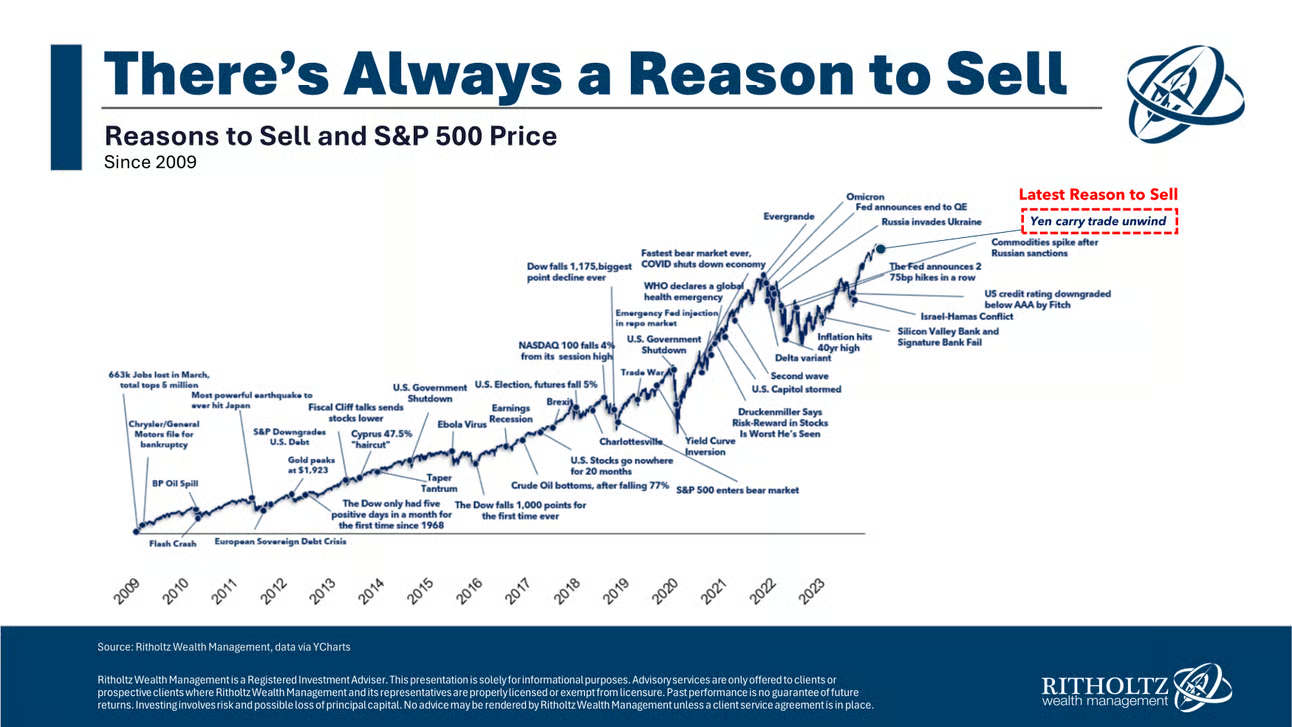
This next diagram comes from A wealth of common sense and shows the market’s returns over different time horizons. It shows your annual return based on when you started investing (the column) and how long you waited (the row):
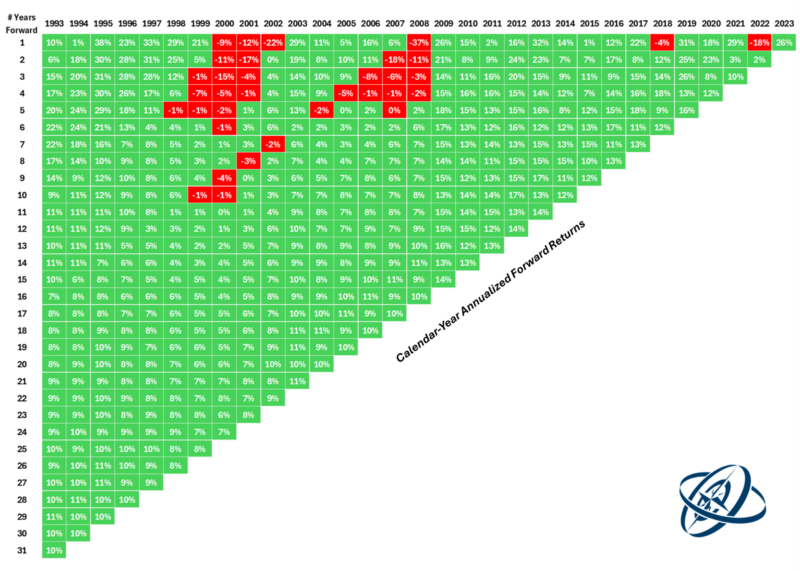
If you invested in 2000, you had negative annualized returns for six years before it turned positive. If you invested in 2008, you had four years of negative returns before turning positive. Those are big bumps.
But the table is overwhelmingly green. And the red chunks are found in periods of enormous turmoil – the dot-com bubble and the Great Recession. The pandemic barely registers a blip!
This may not be the best time to invest in the stock market. You may have to wait until almost a year. Or the year after. Or enter the real estate sector. Or cryptocurrency. But there’s always a reason why it’s not the best time.
Or maybe you should invest today and check your account balance in twenty years.
If you wait long enough, it seems like a good decision.
Invest anyway.
#Invest